Last Click Versus Data Driven Attribution
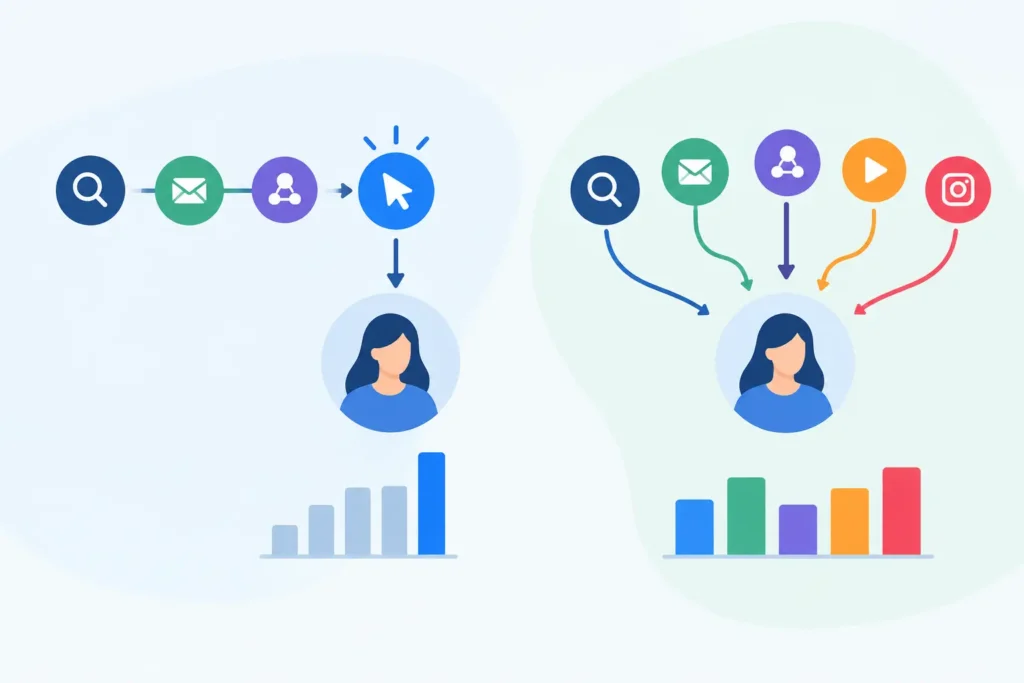
A campaign can produce the first click, build familiarity over three visits, and bring a prospect back after they compare alternatives. Then a branded search ad gets the final click and receives 100% of the conversion credit. If you manage budgets from that report, you may cut the campaign that created demand and increase spend on the campaign that merely collected it.
That is the real stakes in last click versus data driven attribution. This is not a reporting preference. It determines which ads look profitable, which audiences get scaled, and which winners get switched off.
What last-click attribution actually tells you
Last-click attribution assigns the full value of a conversion to the final known marketing touchpoint before the sale or lead. A customer sees a YouTube ad, clicks a Meta prospecting ad two days later, opens an email, and finally searches your brand name before buying. Under last click, the branded search click gets the credit.
The model is simple, easy to explain, and useful for a narrow question: what was the final measurable action before conversion? For direct-response offers with short buying cycles and one dominant traffic source, that can be enough to make practical decisions.
It also gives operators a clean way to assess bottom-of-funnel intent. A high-converting branded keyword, retargeting ad, or affiliate pre-sell page may genuinely be valuable because it closes prospects who are ready to act.
The problem starts when teams treat last click as a complete account of causality. It is not. It systematically favors channels nearest to the sale and can make demand generation look weak. That creates a familiar failure pattern: prospecting gets labeled unprofitable, retargeting and brand search absorb the budget, and the pool of new buyers eventually shrinks.
How data-driven attribution distributes credit
Data-driven attribution uses observed conversion paths to assign fractional credit across touchpoints. Rather than automatically giving everything to the final click, it estimates how different interactions contributed to the likelihood of conversion.
In Google Ads, data-driven attribution uses account data to compare converting and non-converting paths. The exact weighting is not a fixed formula marketers can inspect line by line. That matters. You should treat it as a model-informed estimate, not as indisputable proof that a specific campaign caused a specific sale.
For example, a prospecting campaign might receive partial credit for introducing a buyer, while a retargeting campaign and a branded search campaign each receive credit for moving that buyer closer to conversion. This can produce a more balanced view of upper-, mid-, and lower-funnel activity than last click.
Data-driven attribution is especially useful when customers take multiple steps before purchasing, when several campaign types work together, or when you are trying to avoid overfunding the bottom of the funnel. It can also feed more complete conversion signals back into an ad platform’s bidding system.
But it has limits. The model only works from the data it can see. Missing UTMs, blocked browser scripts, consent restrictions, failed event matching, cross-device behavior, offline conversions, and delayed revenue all narrow its view. A sophisticated model trained on incomplete inputs still produces incomplete answers.
Last click versus data-driven attribution: the practical difference
The biggest difference is not the dashboard label. It is the decision each model encourages.
Last click asks, “What closed?” Data-driven attribution asks, “Which measurable interactions appear to have helped create this conversion?” Both questions matter. Neither should be used alone to declare a campaign profitable or wasteful.
Not sure whether your current tracking can connect clicks to revenue? Take the Free ClickMagick Tracking Assessment to identify potential gaps in your tracking setup.
Consider an ecommerce brand running cold Meta ads, Google Shopping, branded search, and email. Last click may show branded search with a 10x ROAS and cold Meta with a 1.2x ROAS. The obvious move is to protect branded search and cut Meta.
That move may be correct if Meta is attracting low-intent traffic that never becomes profitable. But it may also be wrong if Meta creates the demand that later converts through a branded search. Data-driven attribution may shift some revenue back to Meta, showing that it assisted more conversions than last-click reporting suggests.
The reverse can happen too. A data-driven model can make a broad campaign look more valuable because it appears early in many paths, even though it reaches users who would have converted anyway. That is why attribution is directional evidence, not a substitute for judgment, margin analysis, or controlled testing.
Where data-driven attribution can still mislead you
Ad platforms have a financial incentive to show that their inventory contributes to outcomes. Their attribution tools can be useful, but their reports are not independent audits. Compare platform-reported conversions with your own order, lead, and revenue records before shifting serious budget.
There are four common gaps to investigate:
- Identity loss: A person clicks on mobile and buys later on desktop. If the systems cannot connect those sessions, the path is fragmented.
- Tracking loss: Browser privacy controls, ad blockers, cookie restrictions, and incomplete consent handling can prevent client-side pixels from recording visits or conversions.
- Revenue loss: A lead form may fire a conversion event, but the lead may never qualify, show up, or buy. Counting every lead as equal can inflate a campaign’s apparent value.
- Time lag: Some purchases happen days or weeks after the original click. Short attribution windows can punish campaigns that start longer sales cycles.
Bot traffic and click fraud add another layer. A campaign can receive clicks that look legitimate enough to enter reports but never represent real buying intent. Changing attribution models will not solve invalid traffic by itself. You need clean traffic sources, sensible click-quality controls, and reporting that separates clicks from meaningful downstream outcomes.
Choose the model that fits the decision
Use last click when you need a fast operational read on the final conversion source, especially for short funnels, affiliate offers with a single handoff, or campaigns where the final action is the core optimization point. It is transparent and hard to misunderstand.
Use data-driven attribution when your customer journey includes multiple paid and owned touchpoints, your account has enough conversion volume for meaningful modeling, and you need to protect campaigns that create demand before the final click. It is better suited to budget discussions across prospecting, retargeting, search, and email.
For many advertisers, the stronger approach is to keep both views available. Review last-click revenue to understand where conversions close. Review data-driven credit to understand which campaigns may be assisting the path. Then make budget decisions using contribution margin, new-customer rate, lead quality, refund rate, and conversion lag – not ROAS alone.
A campaign that looks weak on last click but drives new customers at an acceptable cost may deserve protection. A campaign that looks strong under data-driven attribution but produces little incremental lift may deserve tighter limits. The answer depends on your funnel, sales cycle, tracking quality, and confidence in the underlying data.
Fix measurement before buying more attribution software
Do not buy another dashboard because reports disagree. First, check whether your existing setup captures the basics: consistent UTM parameters, properly firing conversion events, purchase values, lead-source data, and a clear distinction between prospects and qualified revenue.
Server-side conversion tracking can improve the durability of event collection, but it does not automatically solve identity resolution or prove incrementality. First-party tracking can preserve more of your own click and conversion data, but it still requires correct implementation and disciplined campaign naming.
If you run paid traffic across multiple platforms, funnels, domains, or affiliate links, an independent tracking layer may be worth evaluating. ClickMagick can be relevant when you need centralized click tracking, first-party tracking options, conversion tracking, and clearer visibility into traffic quality outside the self-reported views of ad platforms. Verify the plan limits, required setup, supported integrations, and whether it captures the revenue events that actually matter to your business before paying for it.
The point is not to chase perfect attribution. Perfect attribution is rarely available. The point is to reduce the blind spots large enough to cause bad budget decisions. When the numbers determine whether you scale, pause, or rebuild a campaign, use numbers you can bet budget on – and keep questioning the parts you cannot see.
Not sure where your tracking is breaking down?
Take the Free ClickMagick Tracking Assessment to identify potential gaps in your current tracking setup.