Why Ad Platform Reporting Differs From Your Revenue
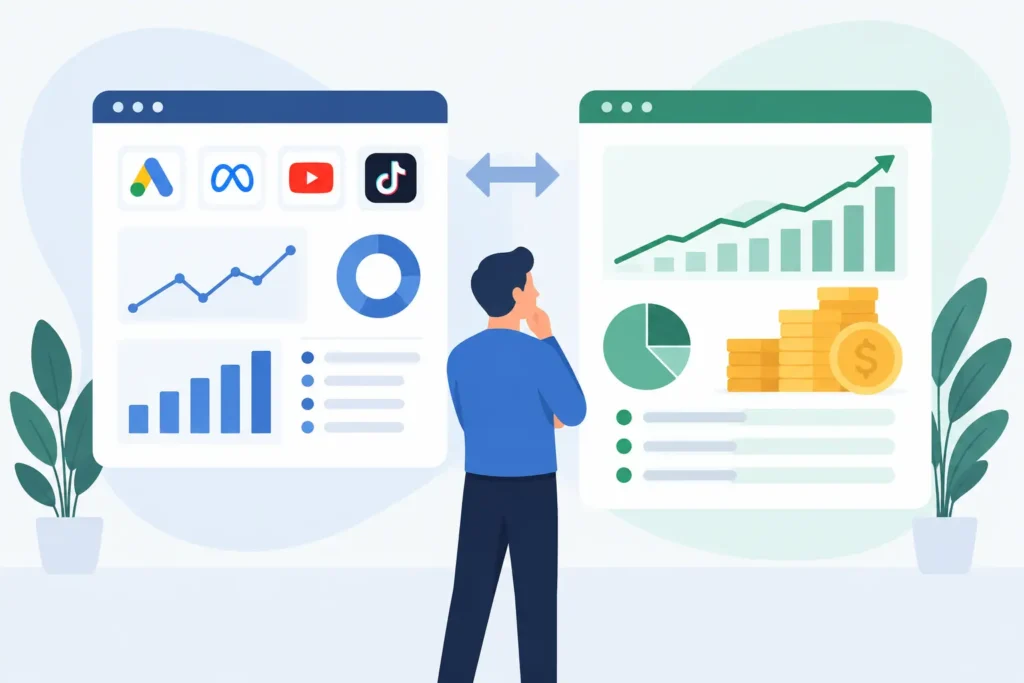
Your Meta dashboard says a campaign produced 42 purchases. Google Ads takes credit for 31. Your store shows 46 orders. Meanwhile, the bank account does not care which dashboard won the argument.
That is why ad platform reporting differs from the revenue you can actually take to the bank. It is not always a setup mistake, and it is not fixed by refreshing reports, changing attribution windows, or exporting another spreadsheet. Each platform is measuring a partial version of the customer journey, using rules built to prove its own value and improve its own bidding.
Relying exclusively on platform-reported ROAS can lead to poor budget decisions when attribution windows, conversion definitions, or tracking coverage differ. Investigate discrepancies before concluding that a profitable campaign was undervalued or that another campaign received too much credit.
Why Ad Platform Reporting Differs From Revenue
An ad platform does not have a complete record of your business. It has a record of ad exposures and the conversion signals it can connect back to those exposures.
That distinction matters. Meta reports the conversions it can attribute to a Meta impression or click under its selected attribution settings. Google Ads reports the conversions it can connect to Google interactions. TikTok, Microsoft Ads, native networks, affiliates, and every other channel apply their own identity signals, attribution models, reporting delays, and credit windows.
Your business, on the other hand, needs to know a simpler but harder answer: which traffic actually created profitable customers after refunds, duplicate orders, phone sales, subscriptions, and operational costs?
Platform numbers are useful for managing a platform. They are not automatically numbers you can bet budget on across the business.
For a broader explanation of why tracking reports disagree, see our free Independent Guide to Ad Tracking & Attribution, especially the section on dashboard differences.
Attribution windows create competing versions of the same sale
Suppose a prospect clicks a Google ad on Monday, sees a Meta retargeting ad on Wednesday, then buys on Friday after typing your URL directly into a browser. Google may claim the sale because the original paid click sits inside its click-through window. Meta may claim it because a qualifying view or click also occurred. Your analytics tool may call it direct. Your ecommerce platform records one order.
None of those systems necessarily has a technical error. They are answering different questions using different rules.
This gets worse when default settings are ignored. A seven-day click window, one-day view window, data-driven model, last-click model, and blended reporting view can all produce sharply different channel totals from the same customer behavior. When every platform claims credit independently, summed platform revenue can exceed actual revenue by a painful margin.
That does not mean view-through conversions are worthless or that upper-funnel ads should receive no credit. It means they should not be treated as the same thing as verified, incremental sales.
Identity breaks before the customer journey ends
The clean customer path shown in a dashboard is mostly fiction. Real people move from Instagram to Safari, from mobile to desktop, from a personal device to a work laptop. They clear cookies, decline consent, use private browsing, block scripts, and return days later through branded search or direct traffic.
A browser pixel often loses the thread at exactly the moment you need it most. Privacy restrictions limit third-party cookie persistence. Ad blockers prevent client-side tags from firing. Browser changes reduce the data available for matching. Consent choices can suppress events entirely.
Server-side conversion events help because they send approved conversion data from your server rather than relying only on a browser tag. But they are not magic. Event quality still depends on what identifiers you captured, whether events are deduplicated correctly, and whether the order data reaching your server is complete.
The practical result is simple: a platform may underreport a campaign that genuinely works because it cannot recognize every buyer. At the same time, it may over-credit itself for a customer who would have bought anyway.
Conversion timestamps do not match reporting dates
Ad platforms often report a conversion against the date of the ad click or impression. Your store usually records revenue on the date the customer purchased. Your CRM may record value when a lead becomes qualified. Your payment processor may settle funds later still.
This creates apparent gaps that are really timing differences. A campaign can look unprofitable today, then gain attributed conversions over the next several days. High-consideration offers, B2B lead generation, subscriptions, and phone-driven sales make the lag even longer.
Not sure whether your current tracking can connect clicks to revenue? Take the Free ClickMagick Tracking Assessment to identify potential gaps in your tracking setup.
Do not judge every campaign on same-day platform ROAS if your buying cycle takes two weeks. But do not use delayed attribution as an excuse to keep funding bad traffic forever either. You need a clear measurement window tied to your actual sales cycle, plus a way to compare early indicators against eventual realized revenue.
The Reporting Gaps That Quietly Waste Spend
The most damaging gaps are rarely dramatic. They are small losses and misclassifications repeated across thousands of clicks.
Bot traffic and invalid clicks can inflate visits, engagement, and even low-quality lead events. Competitor clicks and accidental taps add cost without commercial intent. If your optimization event is a form submit rather than a verified sale, a platform may find more people likely to submit forms, not more people likely to become customers.
Offline and assisted conversions can be difficult to associate with earlier advertising interactions. A prospect may click an ad and purchase after a phone conversation, but the original campaign should receive credit only when a valid connection is available under the chosen attribution method. Missing reporting does not by itself establish the sale’s source.
Then there is the opposite failure: duplicate conversion counting. A browser pixel, server-side event, thank-you-page reload, and CRM automation can each send what looks like a separate purchase unless event IDs and deduplication are handled correctly. Inflated conversion data teaches bidding systems to chase a fantasy.
The issue is not that one report is always lying. It is that each report has blind spots, incentives, and definitions that need to be understood before money moves.
What to Trust When the Dashboards Disagree
Start with the business outcome, not the platform claim. For ecommerce, that usually means paid orders, net revenue after cancellations and refunds, contribution margin, and repeat purchase behavior. For lead generation, it means qualified leads, booked calls, closed revenue, and expected pipeline value.
Then preserve the click-level evidence that connects traffic to those outcomes. UTMs identify the campaign, ad set, keyword, creative, and source that generated a visit. First-party tracking captures that information before a prospect reaches your checkout, form, phone call, or CRM. That record remains useful even when a third-party cookie expires or a dashboard changes its model.
This is the tracking layer underneath the dashboards, not another dashboard that repeats their claims.
A serious reconciliation process compares platform conversions, tracked clicks, verified orders, and backend revenue over the same period. It also uses the same definitions. If one report includes tax and shipping while another does not, you do not have an attribution disagreement. You have a measurement-definition problem.
Look for direction before demanding impossible precision. If a campaign consistently produces strong first-party revenue and healthy margins but receives weak platform credit, investigate the missing signal before cutting it. If a platform reports excellent ROAS but the campaign produces little verified revenue, pause the victory lap and inspect the path from click to sale.
Use platform data for optimization, not final accounting
Where supported and permitted, sending accurate, deduplicated conversion events from server-side systems may improve the completeness of signals available to advertising platforms. Results depend on event quality, identifiers, consent, and configuration; improved delivery does not guarantee better targeting or profitability.
But optimization data and financial truth serve different jobs. A platform needs timely signals it can act on. Your business needs reliable revenue records that account for refunds, fraud, sales cycles, and margin. Trying to force one dashboard to do both jobs is where expensive decisions begin.
Use the platform to diagnose creative, audience, placement, and delivery. Use your owned tracking and backend data to decide whether the spend survives.
Build a Measurement System That Can Survive Change
The goal is not perfect attribution. Perfect attribution is unavailable once humans use multiple devices, decline tracking, and interact with several channels. The goal is durable enough attribution to make better decisions than your competitors.
Use consistent campaign parameters where practical, retain permitted first-party data, and validate conversion events against business records. Investigate suspicious traffic and reporting differences without assuming every discrepancy is fraud or lost attribution. Reconcile confirmed online and offline outcomes when reliable matching is possible.
ClickMagick is built for this job: preserving click-to-sale data in a first-party tracking layer so you can see what to scale, fix, or pause when platform reports conflict. WeTrackEverything may earn a commission if you later choose a paid ClickMagick subscription, at no added cost to you.
Your next budget decision does not need another polished chart. It needs a defensible answer to one question: after real customers, real revenue, and real costs are counted, did this traffic make you money?
Not sure where your tracking is breaking down?
Take the Free ClickMagick Tracking Assessment to identify potential gaps in your current tracking setup.