Best Tracking Tool for Media Buyers in 2026
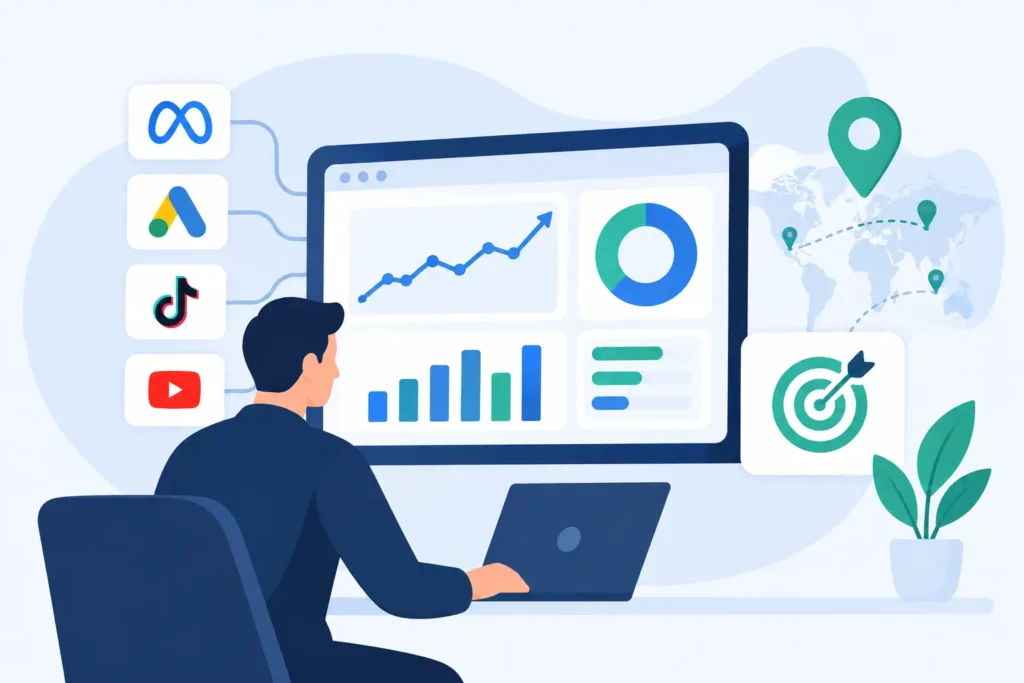
Your Meta dashboard says a campaign is printing money. Your store data says margin is disappearing. Google claims the sale. Meta claims the same sale. Meanwhile, the actual customer clicked an ad on mobile, came back through email on desktop, and purchased after a phone call.
The best tracking tool for a media buyer depends on the measurement problem, existing systems, budget, and implementation requirements. A useful tool can improve visibility into clicks and conversions, but no dashboard or attribution model can establish the full causal effect of every campaign.
Media buyers do not need another dashboard that repeats what Meta, Google, TikTok, and Shopify already say. They need the tracking layer underneath it: first-party click data, reliable conversion capture, invalid-traffic filtering, and a credible path from ad click to revenue.
What the Best Tracking Tool for Media Buyers Must Do
A tracking tool earns its place in a media buyer’s stack when it changes a real decision. Should this campaign get another $5,000? Is the new creative actually profitable? Did the landing page lift conversion rate, or did attribution merely shift between channels? Are you paying for customers, bots, competitors, or repeat clicks?
If the tool cannot answer those questions clearly, it is reporting software, not decision infrastructure.
The baseline requirement is first-party tracking. Browser restrictions, privacy controls, ad blockers, and cookie loss have weakened the pixels that ad platforms rely on. Platform pixels can still be useful, but they are not neutral judges. Each platform has an incentive to claim as much credit as its attribution settings allow because claimed revenue supports more spend.
Attribution gaps can affect budget decisions in either direction. A campaign may be undercredited, overcredited, or measured under a different conversion definition. Investigate discrepancies and compare business outcomes before assuming that one campaign is a winner and another is wasting spend.
A capable tracker should capture the original click through your own controlled tracking layer, preserve source and UTM data, and connect that click to the conversion when possible. It should also support server-side conversion delivery so ad platforms receive cleaner optimization signals instead of relying only on fragile browser events.
The Expensive Gaps Most Tools Leave Behind
Most tracking failures are not caused by a missing metric. They are caused by missing context.
A standard ad dashboard may show campaign-level purchases, but not whether those purchases came from new customers, high-margin products, phone orders, subscriptions, or leads that later turned into closed revenue. An ecommerce platform can show revenue, but it may not preserve the click-level source that explains why the sale happened. A CRM may contain closed-won data while being disconnected from the ads and landing pages that generated the lead.
The result is a set of reports that look complete in isolation and become useless when you try to allocate budget.
The best tools close the gaps that matter most to paid acquisition:
- Cross-device and delayed journeys, where the initial ad click and final conversion happen on different devices or days apart.
- Offline, phone, and CRM-confirmed revenue, where the lead is not the economic outcome.
- Bot traffic, competitor clicks, duplicate clicks, and other invalid visits that inflate spend without producing customers.
- Server-side events, where conversion APIs improve event delivery and give platforms better data for optimization.
- Landing page and funnel tests, where buyers need to know which page produces more revenue, not just more form submissions.
You may not need every one of these on day one. A low-volume local lead-generation account has different needs than a seven-figure ecommerce brand. But if your spend is growing, the gaps compound faster than most teams expect.
First-Party Data Beats Platform Self-Reporting
The practical distinction is ownership.
When your measurement depends entirely on ad-platform pixels, the platform owns the primary record of what happened. You get its version of the customer journey, filtered through its attribution windows, modeling choices, consent rules, and commercial incentives.
With an appropriately configured first-party measurement setup, advertisers may retain useful campaign identifiers and connect some conversions to earlier visits. First-party tracking can be client-side, server-side, or both; it does not necessarily require a redirect before the landing page. Privacy choices and missing identifiers can still prevent matching.
But first-party infrastructure gives you a stable reference point. It helps you compare platform claims against observed click-to-sale performance rather than treating platform reporting as unquestioned fact.
That distinction changes how a sharp media buyer works. Instead of asking, “Which platform says it drove the most purchases?” you can ask, “Which traffic source, campaign, ad, audience, keyword, and landing page produced the most profitable verified outcomes?”
Not sure whether your current tracking can connect clicks to revenue? Take the Free ClickMagick Tracking Assessment to identify potential gaps in your tracking setup.
That is a much harder question. It is also the question that protects margin.
How to Evaluate a Tracking Tool Before You Commit
Start with your buying decisions, not a feature checklist. If you optimize paid social, you need campaign and creative-level visibility that survives browser loss as well as possible, plus server-side event support. If you buy search, preserving keyword and UTM detail may be central. If you run calls, booked appointments, or high-ticket sales cycles, offline revenue matching matters more than instant purchase counts.
Then test whether the tool can do three things without turning your team into a tracking department.
First, it should make link management reliable. You need campaign links that preserve the traffic source, placement, ad, audience, and other identifiers required to diagnose performance. If link creation is error-prone, your reporting will be error-prone before the click ever happens.
Second, it should connect conversion events back to those links. That includes ecommerce purchases, lead forms, upsells, subscriptions, calls, and imported CRM outcomes where relevant. A tracker that records clicks but cannot reconcile them with meaningful revenue is only half-built.
Third, it should make action obvious. You should be able to identify waste, isolate profitable traffic, compare pages, and decide what to scale, fix, or pause. More data is not the prize. Faster, better budget decisions are.
Also look closely at data retention, reporting speed, bot filtering rules, integrations, support quality, and implementation burden. The most sophisticated enterprise attribution system may be excessive for an affiliate marketer who needs dependable tracking this week. Conversely, a basic URL builder may be inadequate for an agency managing multiple clients, offline conversions, and serious spend.
Flat pricing matters too. Revenue-share pricing can become painful precisely when your tracking starts proving its value. Know what your cost looks like when volume increases.
Why Conversion APIs Are Not a Complete Fix
Server-side conversion APIs are worth using. They can improve event delivery, event matching, and platform optimization when browser pixels miss conversions. But they do not magically solve attribution.
A conversion API sends event data back to the ad platform. It helps that platform learn from more of the outcomes you value. It does not independently verify whether the platform deserves credit for every conversion it receives.
Think of it this way: better event delivery helps the algorithm. Independent first-party tracking helps you govern the algorithm.
You need both. Send clean, deduplicated events back to the platforms so they can optimize. Maintain your own source of truth so you do not let those same platforms grade their own homework.
A Practical Recommendation for Serious Buyers
For media buyers who need an accessible first-party layer rather than a bloated enterprise analytics project, ClickMagick is built around the operational problems that actually cost money: click tracking, attribution, bot filtering, conversion tracking, server-side events, and landing-page or funnel split tests.
It is not a promise of perfect visibility. No vendor can honestly make that promise in a privacy-constrained environment. The value is having a more durable record than platform pixels alone, then using that record to make better calls with imperfect but far more useful data.
Disclosure: WeTrackEverything may earn a commission if you start a paid subscription through its recommendation. That does not increase your price.
The Test That Matters Most
Do not judge a tracking tool by the first dashboard you see. Run it against a real campaign with meaningful spend. Compare its click and conversion records with your platform reports, store data, CRM outcomes, and call data. Look for the discrepancies that change a decision.
If it reveals that a campaign you planned to pause is actually profitable, it has paid attention to the right problem. If it exposes bot-heavy placements or a landing page that leaks paid traffic, it has protected budget before the waste becomes routine.
The most useful tracking tool is the one that addresses a documented measurement need at a reasonable cost. Compare your existing capabilities, verify the accuracy of conversion records, and make uncertainty visible before committing more budget or purchasing additional software.
Not sure where your tracking is breaking down?
Take the Free ClickMagick Tracking Assessment to identify potential gaps in your current tracking setup.