Does Systeme.io Track Which Campaigns Generate Sales? What Its Reports Can and Cannot Show
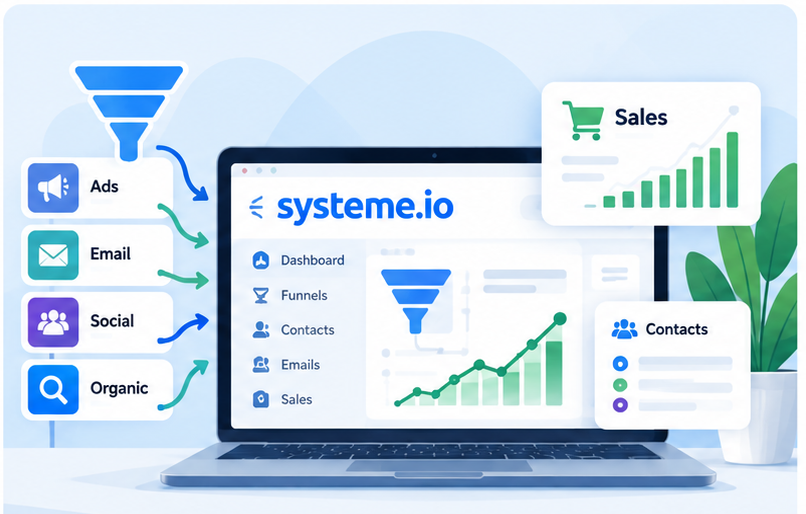
If you’re using Systeme.io to build sales funnels, capture leads, and sell products, you may eventually ask: Which campaigns are actually generating revenue?
Systeme.io provides useful pieces of the picture, including contact records, UTM parameters, and transaction data. But those pieces are not necessarily connected into a complete campaign-level sales attribution report. Understanding the difference can help you decide whether your existing setup is enough.
What Systeme.io can track
Systeme.io combines funnel building, email marketing, automations, and online selling. Its contact records can retain campaign information captured at opt-in, while its sales infrastructure records transactions. Those are useful capabilities—but capturing a lead source and recording a later purchase are not the same as automatically attributing revenue to a campaign.
How UTM tracking works
UTM parameters are labels in marketing links that describe traffic sources and campaigns. Systeme.io can store those values when a visitor opts in through a funnel with Store UTM parameters enabled. The captured fields can then be included in contact exports. This can help identify campaigns generating subscribers, but it does not by itself identify the campaigns generating revenue.
Does Systeme.io automatically attribute purchases to campaigns?
Not through a built-in UTM-based sales attribution report, according to Systeme.io support’s October 2026 clarification. The platform records purchases, but it does not automatically turn stored opt-in UTMs and later transactions into a complete campaign-level revenue attribution report. A missing attribution report does not mean a sale went unrecorded.
Can you connect contact UTMs with later purchases?
Potentially. Support explained that contact UTM information and transaction records can be exported separately. If the same email address appears in both datasets, a business may be able to reconcile the records in a spreadsheet or another reporting system.
- The original UTM parameters must have been captured.
- The relevant export columns must be available.
- Different email addresses can prevent reliable matching.
- Manual reconciliation may be incomplete for complicated customer journeys.
For a simple funnel, occasional manual reporting may be enough. For others, it can become burdensome.
Not sure whether your current tracking can connect clicks to revenue? Take the Free ClickMagick Tracking Assessment to identify potential gaps in your tracking setup.
What about webhooks and automations?
Systeme.io supports webhook events such as opt-ins and new sales. Those events can support external reporting workflows, but a webhook does not automatically solve attribution. The receiving system still needs a dependable way to connect the sale to earlier campaign information. Support did not confirm that original UTM fields are automatically included in the documented sale webhook payload.
When built-in reporting may be enough
Additional tracking software may be unnecessary if your main goals are collecting leads, sending follow-ups, managing a straightforward funnel, and reviewing sales records. Start with the decisions you need to make and check whether your current reporting answers them.
When dedicated attribution software may help
If you need detailed campaign-level revenue comparisons, more complex conversion measurement, or an explanation for differences among advertising dashboards, specialized tools may be worth evaluating. Our independent ClickMagick review explores one such option, including its limitations. Another subscription adds cost and implementation work; it should solve a clearly identified problem.
Should you use Systeme.io and ClickMagick together?
Possibly, but not automatically. Systeme.io can operate a funnel while dedicated software measures aspects of advertising performance. The combination is only worthwhile when the specific integration, available data, budget, and reporting needs justify it. Two tools do not guarantee perfect attribution. For broader context, read our independent guide to ad tracking and attribution.
The bottom line
Systeme.io offers useful funnel, contact, automation, and transaction features. It can capture opt-in UTMs, and some users may be able to reconcile that information with later purchases. It should not be mistaken for a complete native UTM-based revenue attribution system. Use the reporting you already have first, and add complexity only when it addresses a real gap.
Explore Systeme.io
If you’re evaluating software for landing pages, email follow-ups, or sales funnels, you can explore the official platform and compare its current plans.
Explore Systeme.io’s Official Website ↗
Affiliate disclosure: WeTrackEverything may earn a commission if you register or purchase through this link, at no additional cost to you. Our educational assessment remains independent.
Sources and further reading
- Systeme.io: UTM tracking documentation
- Systeme.io Support correspondence with WeTrackEverything, October 11, 2026, clarifying opt-in UTM capture, transaction records, exports, and attribution limitations.
Not sure where your tracking is breaking down?
Take the Free ClickMagick Tracking Assessment to identify potential gaps in your current tracking setup.